IMPORTANT DISCLAIMER: The information and experiments described in this article are for educational and informative purposes only. Attempting to intentionally bypass the control systems of microstock agencies is a direct violation of their Terms of Service. If you are caught using evasion techniques, such as adversarial perturbations, the risk is not just a simple rejection of your file, you may also face immediate account termination and the potential loss of all accrued royalties. We assume no responsibility for the misuse of this information or any consequences regarding your contributor accounts.
If you have ever tried uploading photos or videos to agencies that explicitly prohibit AI-generated content – such as Shutterstock, iStock / Getty Images, or Depositphotos – you may have encountered an almost instantaneous rejection.
But how do these platforms determine with such certainty that a file was generated by an algorithm? Many contributors mistakenly believe the “secret” lies in the file’s metadata, or perhaps that human reviewers have become exceptionally skilled at spotting typical AI artifacts during manual inspection. In reality, the truth is more complex. While manual review still plays a role in identifying anatomical or physical errors, modern detection systems are far more sophisticated and rely on deep-set digital forensics.
Here is a look at the actual mechanisms behind microstock AI filters.
The Hidden Fingerprint
Every AI model leaves characteristic, systematic patterns known as fingerprints that a real photograph or video simply does not possess. Diffusion models, including popular ones like Midjourney, Flux, DALL-E, Google Nano Banana, and Stable Diffusion, generate specific traces during the denoising process. These patterns are deeply embedded in the image structure and are easily identifiable by specialized software. Each specific architecture, whether it is a version of Midjourney or a custom model, has its own unique signature.
Micro-textures and Statistical Distribution
Real cameras produce sensor noise with a very specific statistical distribution. They leave behind consistent chromatic aberrations, residual Bayer patterns from the demosaicing process, and natural variations in exposure. AI-generated images, by contrast, often appear “too clean” or exhibit statistical patterns that are too regular compared to the physics of the real world and the mechanics of a physical camera sensor.
Our Practical Test
To demonstrate how this works, we used one of the most popular AI detection tools available, Sightengine (though others like Hive are equally common). While we cannot know exactly which proprietary software each microstock agency uses, these tools allow us to understand the underlying logic.
We started with a real image, captured with a Nikon D800, showing a mechanic working on a car:
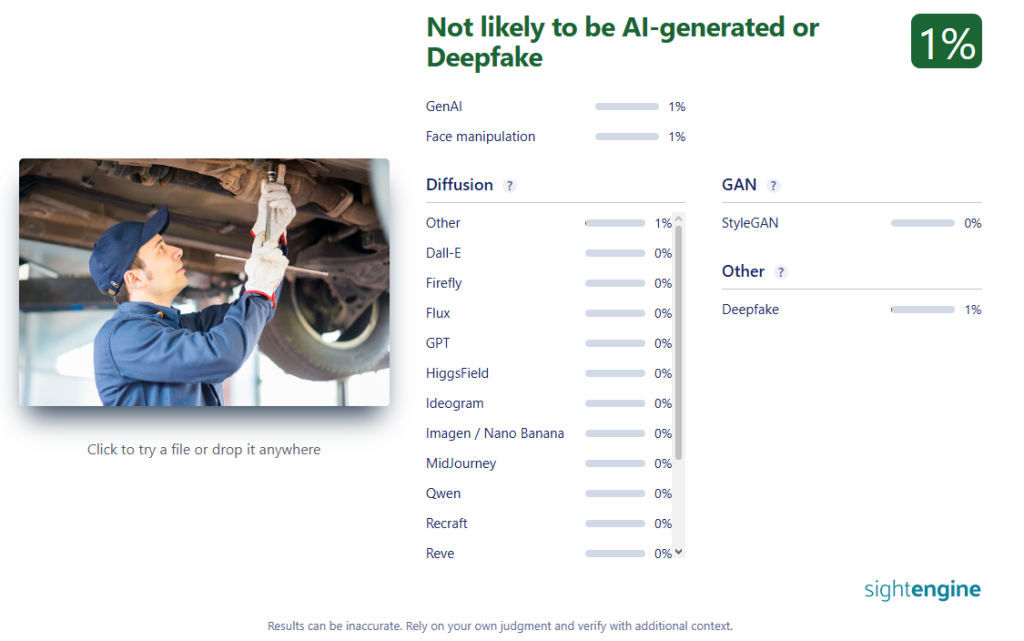
As expected, the system correctly identified it as a real photo, assigning only a 1% probability of it being AI-generated.
Next, we tested an AI-generated image. To make the test more rigorous, we performed a specific trick: we took the AI image layer and pasted it into the previous Nikon D800 file using Photoshop. This ensured that the file’s metadata remained that of the real camera, effectively removing EXIF data from the equation:
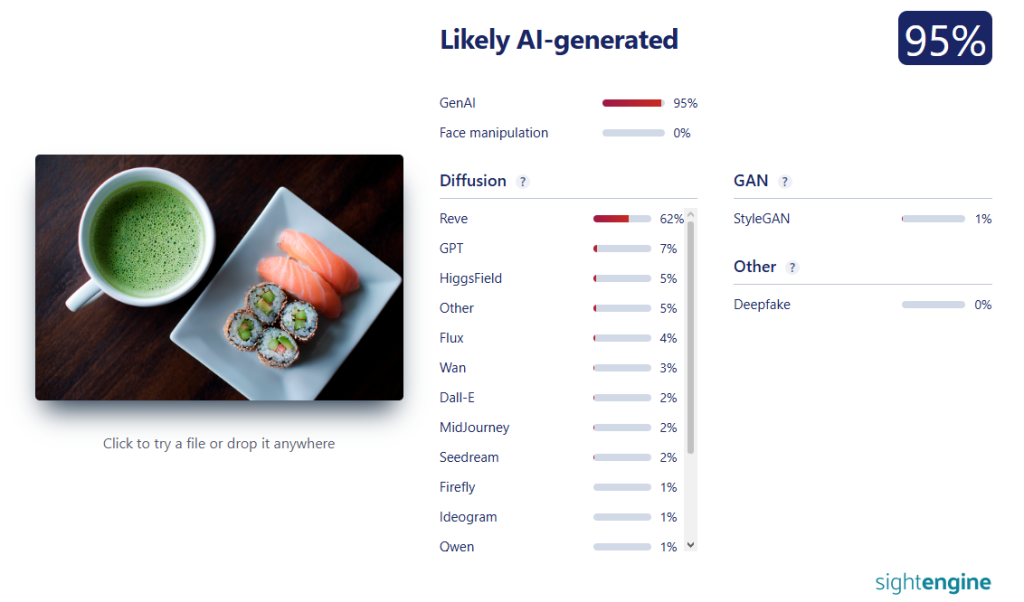
Despite the “real” metadata, the system identified it as AI-generated with 95% certainty. Visually, the image is incredibly photorealistic, and many human eyes would struggle to mark it as fake. However, the software detected the mathematical signature hidden within the pixels effortlessly.
Attempting to Mask the Traces
We then tried to see if we could “hide” this invisible watermark. We applied several layers of noise in Photoshop to see if it would confuse the detection algorithm.
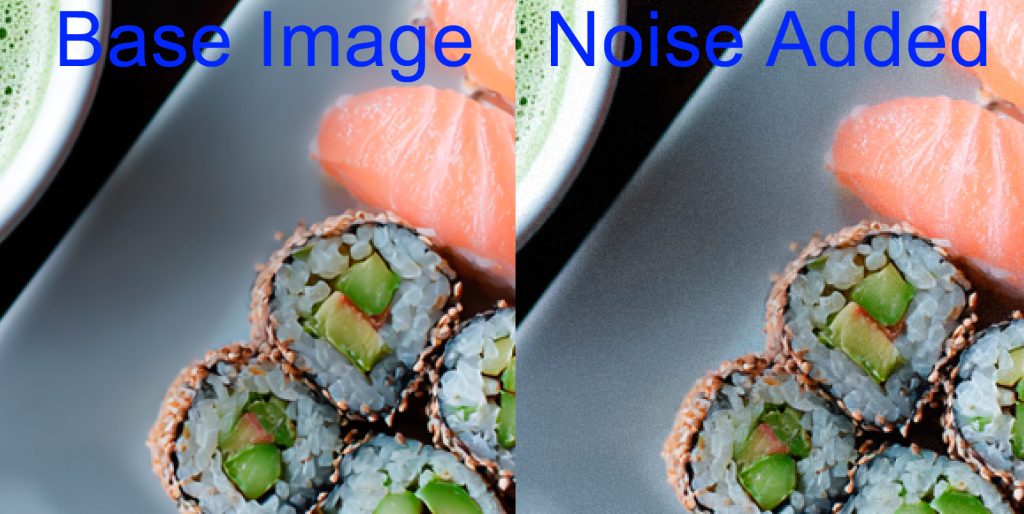
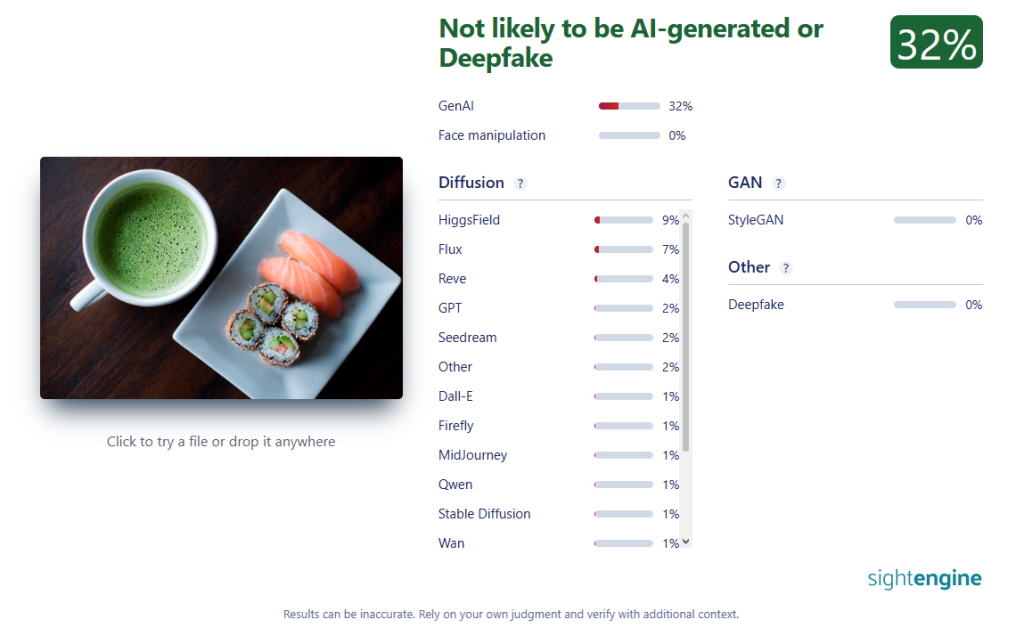
By adding this background noise, the detection did become more difficult for this specific image. The probability rating dropped from 95% to 32%. But what happens if we use a more advanced method? We ran a Python script designed to generate noise through “Adversarial Perturbation” using a GPU. This technique is specifically designed to confuse neural networks.
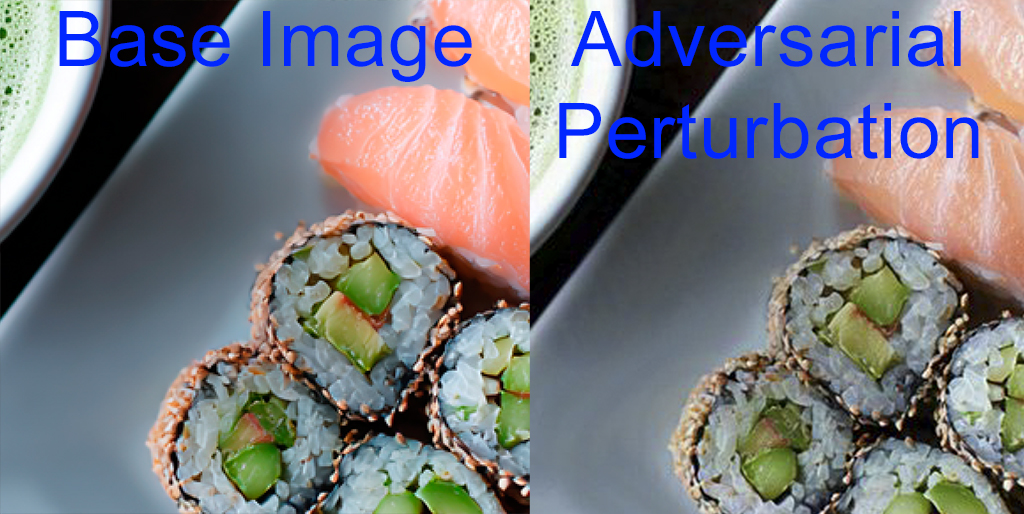
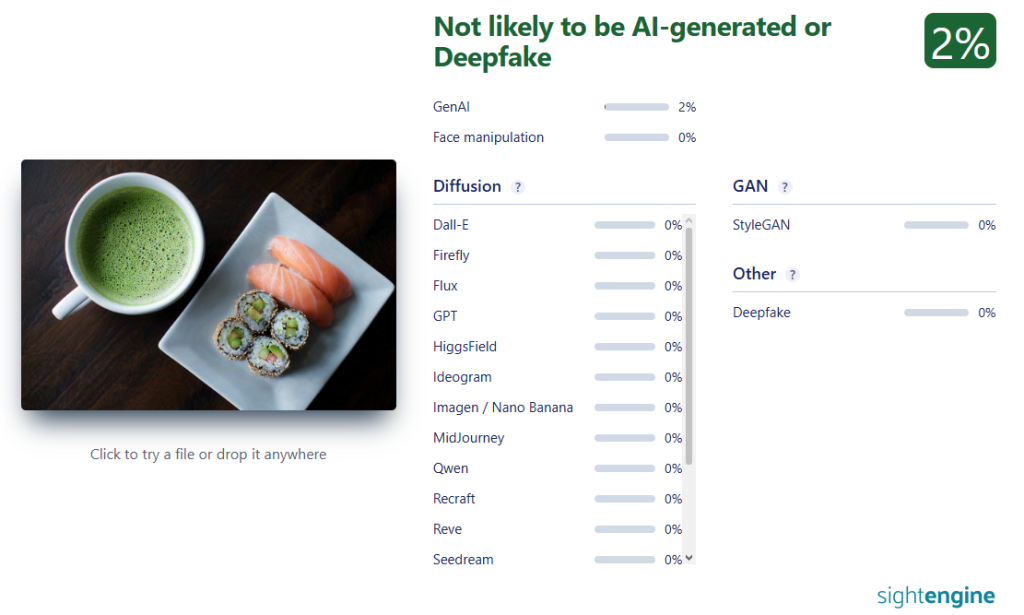
The result was a drop in detection probability to just 2%. On paper, the experiment worked. However, there is a significant catch: the image quality suffered. While it might not be immediately obvious in a complex image like the sushi, it becomes glaringly evident in photos with uniform colors or smooth bokeh:

In the sky of this image, for instance, you can see blotches and artifacts where the noise has compromised the file. In the world of microstock, such quality issues could lead to a rejection for “Technical Quality” regardless of whether it was flagged as AI.
The Problem of Scalability
The effectiveness of these techniques varies wildly. While the sushi image was “lucky,” other images remain highly detectable even after heavy manipulation. For example, we applied the “Adversarial Perturbation” noise to this AI generated image, but it was still detectable:
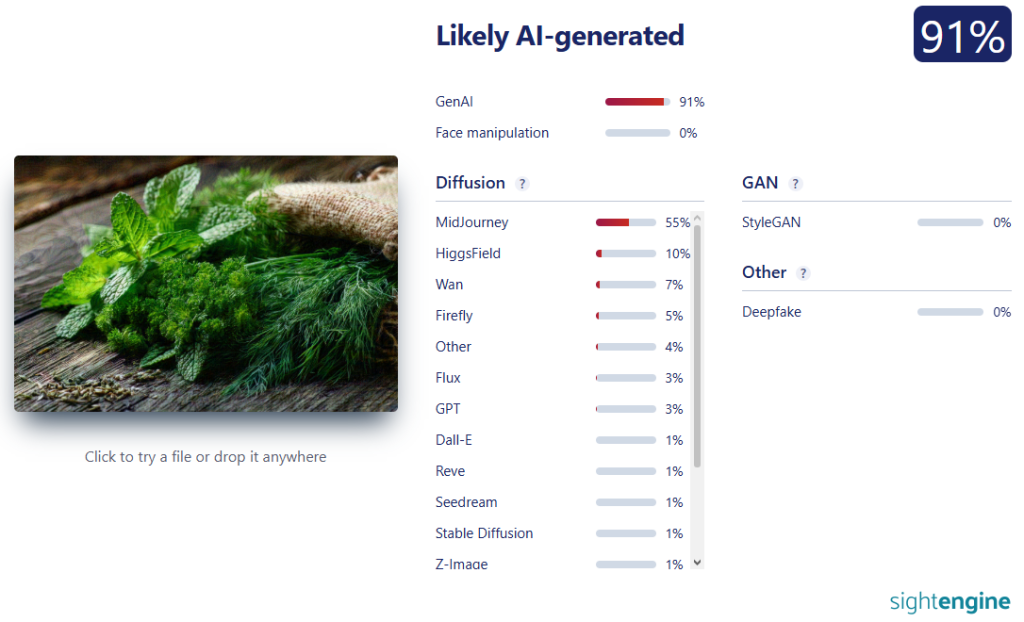
Furthermore, common post-production steps like upscaling with Gigapixel or similar AI tools often restore the very patterns that the noise was meant to hide. For any noise-based evasion to work, it would have to be the very last step in the workflow, often leaving the final product looking unprofessional.
Ultimately, AI detection systems are a moving target. They are far more robust than simple metadata checks, and trying to outsmart them is a cat-and-mouse game that contributors are likely to lose. For those looking to build a sustainable portfolio, we believe that transparency and adherence to agency guidelines remain the only viable long-term strategies.